Unit 2 : Task 2 Research Log

For my research, I didn’t use any secondary research so I cannot compare that, but I am able to go into the main reason and strengths and weaknesses I had while using primary research.

What I did for my primary research – My main source of information was a questionnaire/survey I made for this topic. I asked 11 people 10 questions. I would’ve had more but I needed this information in a matter of time. All 11 people had practically the same answers. Although they were different wordings, they understood the main concept with multiple thoughts, which is good. This is what I wanted from it. Although the people I asked were younger so they would assume to be biased but the answers I had weren’t. They were aware of it. One of the only complaints I can say about my research is that I only had 11 people, I would’ve liked to have more for many other thoughts and opinions.

Some people took the survey very seriously and gave great answers, a few answers didn’t really help as they didn’t give a reasonable reason. So that’s another reason why I wanted more people.

Unit 2 : Task 1 – Research; Primary, Secondary, Quantitive & Qualitative on Social Media affects

ASA – Advertising Standards Authority –

This is the UK’a biggest independent advertising regulator. They basically make sure to not make ads air that can cause harm, abuse, misleading or offensive. They also take in complaints and constantly monitor adverts to make sure they are applicable.

I will be researching the brand and target audience for that brand in this task.

My brand is called Quorn, was founded in 1985 and is an alternative for meat. So, people who would want to use this are either vegetarian, vegan or just trying to cut down on meat by using Quorn. Their target audience is for anyone who is one of those three things I just listed.
Screen Shot 2018-10-22 at 11.58.15.pngScreen Shot 2018-10-22 at 11.59.13.png

Research Plan –

For my research, I will be using primary research throughout. This will help me in many ways as I am having people’s personal preference, their thoughts and overall opinions. Secondary research would help but isn’t necessary as I am gaining statistics and factual information, I would prefer to ask people myself with my own questions and that would be a downside for me if I chose to do any secondary research.

Of course my main audience is from teens or young adults in their young 20s as this is the main demographic for social media and especially how it is is a big part of their lives. I will be interviewing older people in my video for other perspectives.

Primary Research – 750 words

Questionnaire

I made a ten question questionnaire asking people what their thoughts and experience is on social media and how it is able to affect teens live’s and how it has a big impact and part of their life.

Here are the questions I asked;

Question 1 – Is social media a main aspect of your life?

Question 2 – Has it always been a main aspect?

Question 3 – If it wasn’t a main aspect, what changed that?

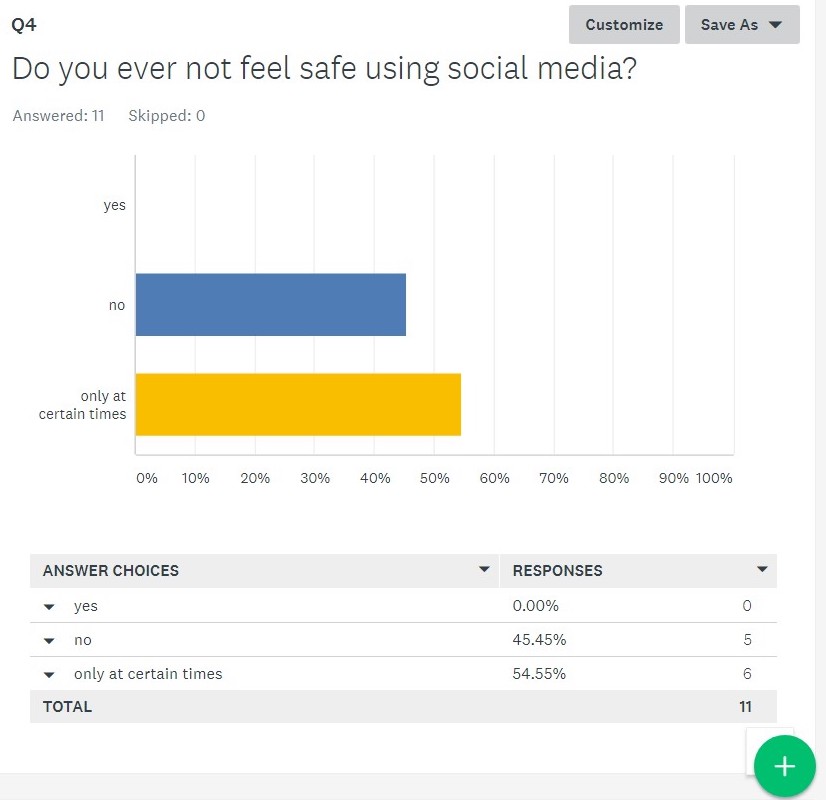
Question 4 – Do you ever not feel safe using social media?

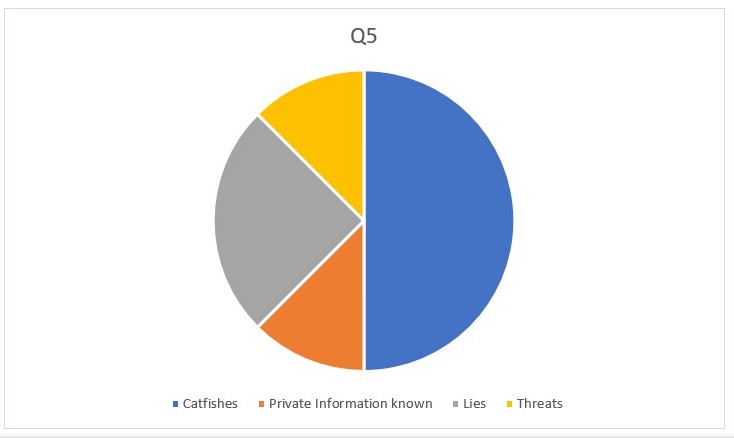
Question 5 – Why is that?

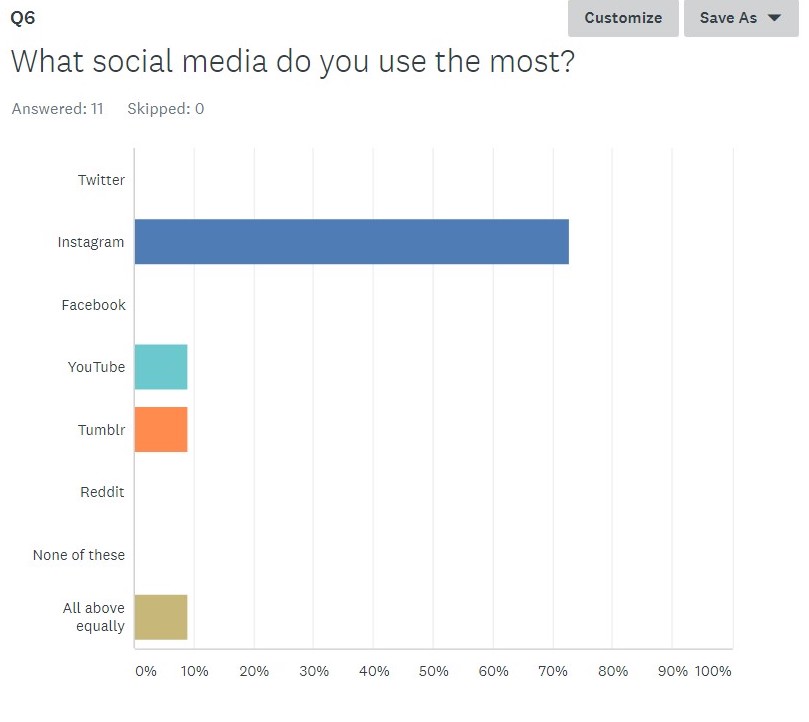
Question 6 – What social media do you use the most?

Question 7 – Why do you use that certain social media the most?

Question 8 – Do you feel like social media has a huge impact on teenager’s lives?

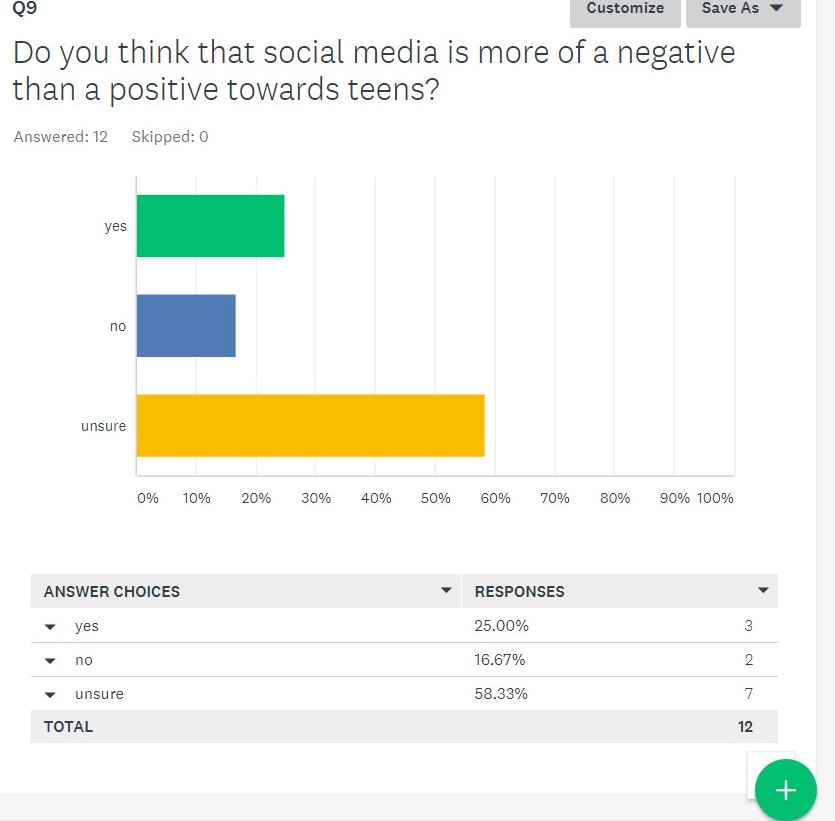
Question 9 – Do you think that social media is more of a negative than a positive towards teens?

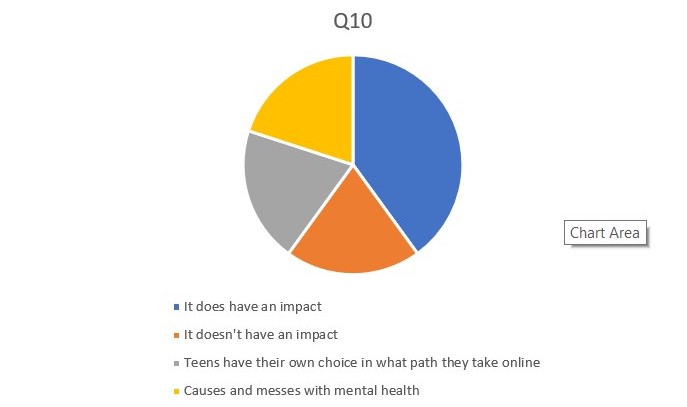
Question 10 – What is your honest opinion on social media? Do you think it affects teens negatively the same way everyone else thinks so?

On my survey I had 11 people answer 10 questions about social media and the impact it has on teens and even young adults. In this, I asked for their opinions and if they have been impacted by social media and if it has a big part of their lives. I will be analysing the questions and be showing graphs as my main source of primary research.


Question 1
questionnaie 1.jpg

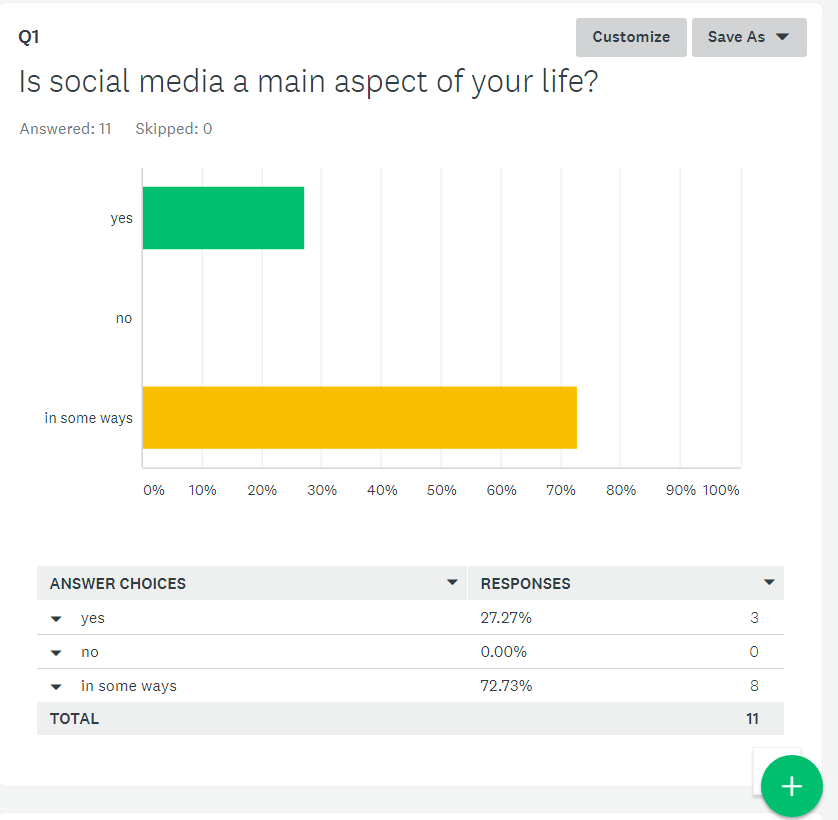
Question 1 shows me asking the question and them answering. Out of 11 people, not a single person said social media is not a main aspect of their lives. This can show us how over the past 10 years social media has grown so big and becoming a must within our lives and this can be proven from the answers in the next question.
2.jpg

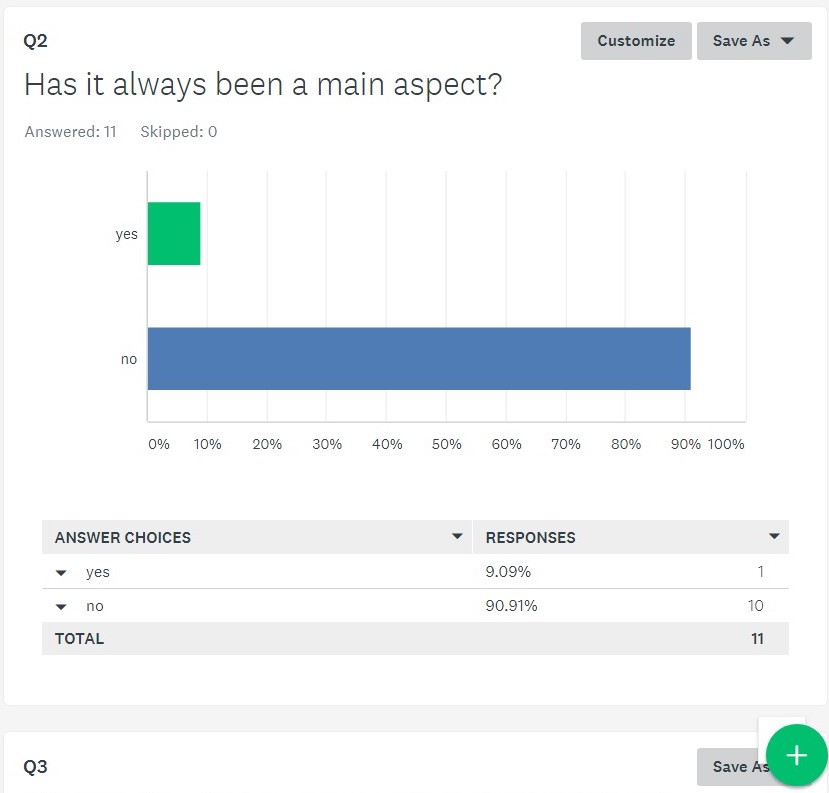
I asked them if it was always a main aspect and out of 11 people 10 said it never was. This can show from the first question that is now is a big aspect but it never used to be. This again just can show how technology is a must have within this society and probably will always will be, if within 10 years they have become so dependant and reliable to it, who knows what will happen in another 10 years?
3 pie.jpg

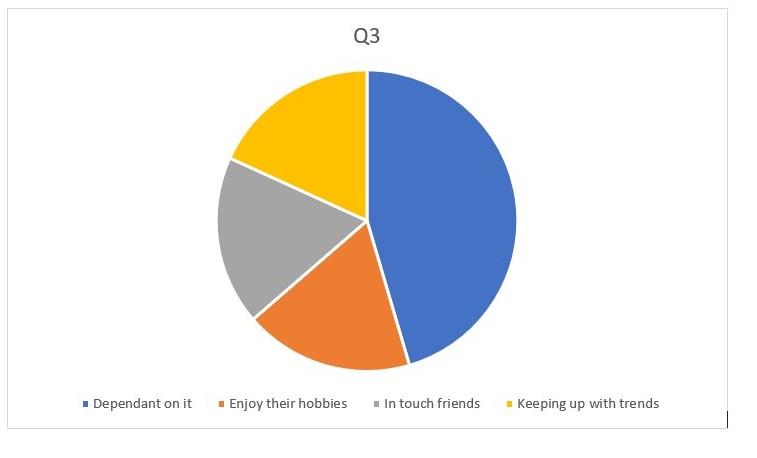
In the third question, I asked “Why did it become such a big aspect?” and then turned it into an pie chart of all the common answers. As you can see, almost 50% said that they are dependant on it, some in this category have even said that they would feel peer pressured into using it so often because so many people are using it.
3.jpg

I asked if they felt safe, and of course no one said yes. Why would they? Although over half the people did say only at certain times. This can possibly show the fact that they are aware of the dangers of heavy use of social media yet there are some people who give out so much information about themselves. So, this question basically shows that people can be smart enough to use it all the time and be careful and there can be people who are stupid enough to do so.
5.jpg

This follow up question is from Question 4. Where I asked what didn’t make them safe. Half the amount of people said that they are scared by people who are pretending to be someone else to lure them in. Now of course all of the reason are equally bad yet some people don’t see the dangers.
6.jpg6.5.jpg

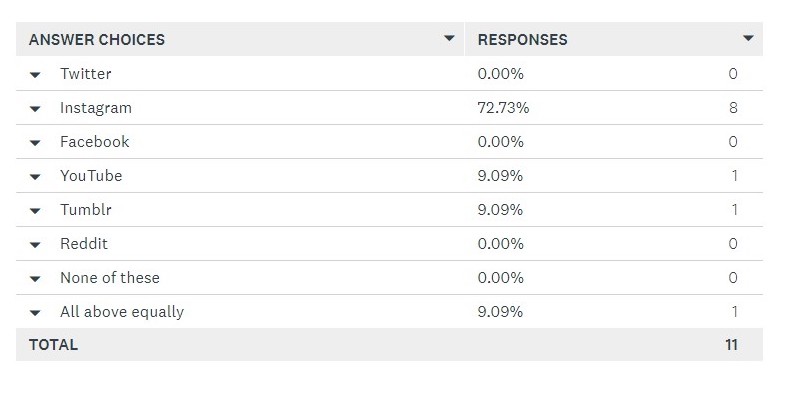
This one doesn’t really show much, most information will be used in the next question but it is interesting how 72% of people use Instagram.
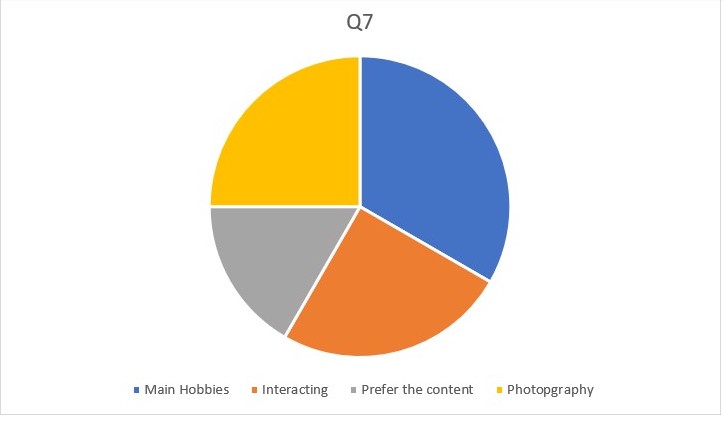
7.jpg

Carrying on from the previous one, I asked why they use that social media the most. Most of the answers are pretty equal but more people have said that it is their main hobby or that they post content of their hobbies one there. This is what social media is used for and it is good that they still continuing to use this. 8.jpg
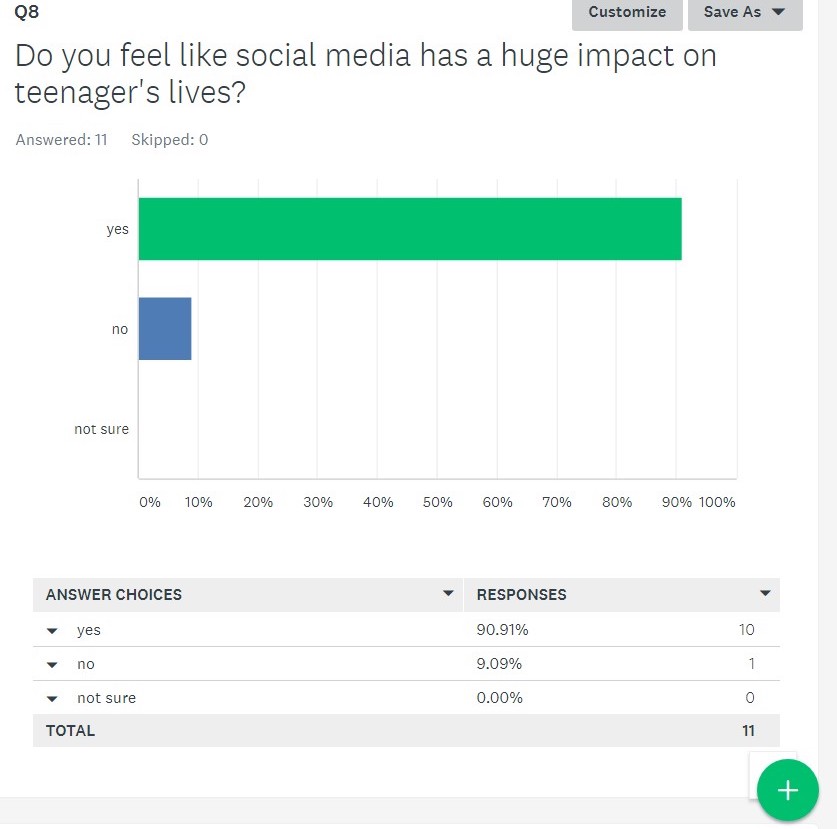
Here is one of the big questions. 10 people out of 11 have said that they think social media has a huge impact on teenager’s lives. This is able to show that people know that social media in 2018 is so prevalent and important and can change so much.
9.jpg10.jpg

Here, I asked if they thought if it was more of a negative on Teen’s social lives. 58% said they were unsure, which can make sense in a way that they haven’t experienced it as a teen or they are still experiencing it. The pie chart shows that it definitely does have an impact.

Secondary Research –

I found four websites about this topic and I will talk about them.

First website – https://www.loebigink.com/how-does-social-media-effect-youth/

This blog was written by Nia Crawford and it’s showing about the fall of teen’s awareness of the real world and how they’ve become so immune and focused onto social media. It also shows the benefits of social media

Second website – https://www.independent.co.uk/life-style/health-and-families/social-media-mental-health-negative-effects-depression-anxiety-addiction-memory-a8307196.html

This article by Independent, written by Sabrina Barr shows six different ways that social media affect mental health. They speak about how people are too addicted to it and having a big following can be heavy as you need to be so careful with what you say.

Third website – https://www.dove.com/uk/dove-self-esteem-project/help-for-parents/talking-about-appearance/how-does-social-media-affect-teens.html

This article was made by Dove UK and doesn’t have a name of whom it is written by. The article shows how teens may have too much information shown online leaving them vulnerable to anything, how teens want to become popular and how it can also knock their self-esteem.

Fourth Website – https://childmind.org/article/how-using-social-media-affects-teenagers/

This article by Childmind, written by Rachel Ehmke tries to help parents into lowering the risk for their children and teens. They talk about the big risks like people stalking, etc. and how it will impact them in the future.

 

Unit 2 : Reece and Test Shot Write Up

Reece Write Up –

I needed two of the reece checklists as I am doing two locations in which I ticked off all the correct boxes.

Things I ticked;

Camera
Mobile Phone
Notebook
Programme Risk Assessment
Checklist
Explain Details
Explain Intentions
No passes required
No copyright issues required
No children’s details
No neighbour disturbance
No risk of trespass
No tidal waters
No boats
Position of sun
Window direction
Power Supply
Size of location
No strobing
TV/computer screens
Is on Floor level
Secure place for kit
Cables
No smoke alarms/sprinklers
Listen
No traffic/roadworks
No aircraft
Electrical Hazards
No schools
Weather
No background music
No air con
Wooden floors

Test Shots

test shot 1.jpg

test shot 2.jpg

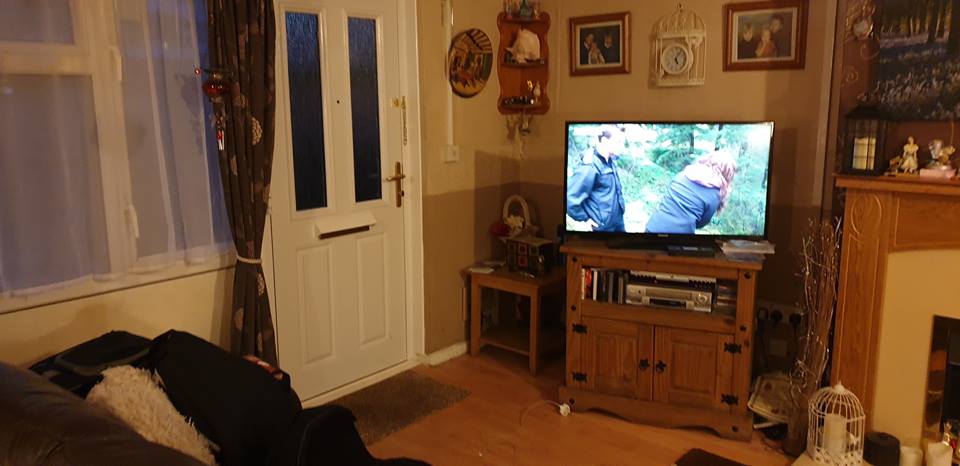
These are my images for the test shots, this is the only location I filmed in and it was safe. While filming we had no issues with the setting although the lighting wasn’t good.

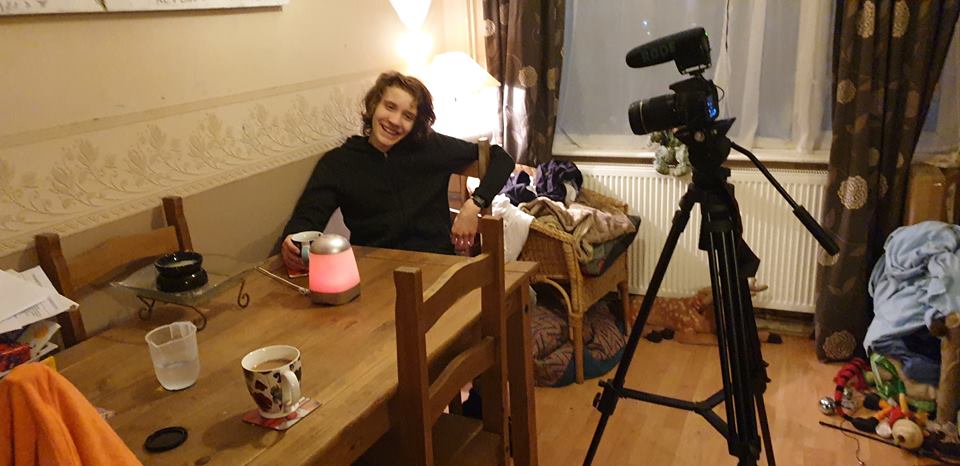
Location was small and dim too

Unit 2 : Task 7 – Evaluation

In this assignment, I was set out to research a serious issue within teenager and young adult’s lives that is relevant towards this society. I was then asked to create a short factual film about that topic. I was to get either primary or secondary research, or both, the film could be done in any format so I decided to do a short interview with 3 people varying from different ages and asking them the same questions along with some shots of someone using a phone/laptop, etc to add to the film. The topic I chose was about social media and how it has such an impact on todays young generation.

My original idea was going to be about obesity but I could not think of anything creative or good enough in a certain amount of time and I didn’t feel comfortable asking people personal questions. But this new idea I had I preferred a lot, it’s a very serious issue that can have very dreadful consequences and it is also relevant to this time.

I have now done filming and editing my project and now will be doing the what went well section.

What Went Well?

The first task for me to do was to think about the topic. I originally changed the idea at first and I think it was for the better as this is more relatable towards teens. I was then given 7 tasks, I needed to find a cast and book equipment and then think of a film for the storyboard. The cast I chose was good, I needed three people from three different age groups and so I chose my friend, who’s 18, my mum, who’s 44 and my nan, who’s 66. They weren’t bias either so it helps with my video. I booked the right equipment and it was easy to film the scenes I needed.

What Didn’t Go Well?

Since this was my first big assignment/project, I had a lot of issues and problems that could definitely be changed next time or if I did it again. The first is to plan it a little better, make sure the topic will be suitable for the video length because my video is 2 minutes and 30 seconds. Which is over the limit, but it wouldn’t make sense if it were only 2 minutes. Second is to lower the ISO to around 400 or less to make the footage less grainy, this will help if I get proper lighting for the filming. Third is to make sure the audio is good, the audio I have is decent but could definitely be better. Since the lighting was off, I could’ve done it during the day time so it has natural lighting.  When I converted the video it was really low in quality for some reason. Not sure why that is because on Premiere Pro it was fine.

Feedback

I asked four people in my class what they thought about my video with a quick questionnaire; here are the results and questions;

Question 1 – Do you think that the video gave information about the impact of social media?

Answers –

Four people ticked yes

Question 2 – Do you think that the video is useful for people who are unsure about social media?

Answers –

Four people ticked yes

Question 3 – What is your opinion on the video?

Answers –

Levi; Very good video, enough subject/people getting interviewed, good music, good actors. format is enjoyable.

Harri; very good, audio clarity is good, camera focus is on point.

J; I think that the information that was presented was useful to people that don’t use the internet.

Tyler; it was well edited, good background music, weird lighting sometimes.

Question 4 – Any Feedback?

Answers –

Levi; Start titles to show longer, great video but target audience is 16-24 year olds so maybe make 3 actors who are of that age but very different, slow down pace of music and add a few different scenes.

Harri; Export it as an mpeg.4, change the music and twitter scene.

J; Put the ISO down to around 100 or 400 so that the footage does not have any grain.

Tyler; Don’t have the weird lamp.

My thoughts –

I respect and understand people’s opinion and feedback on my video, I will be sure to make my best in changing these in future projects.

So, overall. I think the video is decent, it can definitely be improved upon but for the topic, time and actors I think it went well.


Lighting and the start of film, directors and camera cuts.

Today I learnt about the various types of lighting within shots(scenes) or pictures. I found this very interesting. You have multiple lighting techniques, one is the 3 way. Which consists of 3 of them, one being the key, this is the brightest light that’s on the right side of the object/person and then you have the fill light, which fills in all the shadows the key light brings, and finally you have the backlight, which helps divide the object/person from the background.

You can also have a key light and a backlight which makes it Noir. It shows the contrast between the person where some of the face is light and some of it is darker. This is normally used in old silenced movies and black and white movies.

You also have a Spotlight lighting technique which is basically just a key by itself. This will focus on the object/person entirely while the background and surroundings are just completely dark.

With old films, films developed from theater (as shown in really early films) as you can see it’s just sets where actors/actresses bring on props by dragging it, they act over the top to emphasis the fact they are not able to speak and they also break the 4th wall as it’s like a theater. This obviously evolved.

Early films like these would mainly be shown in carnivals or little events as no one really knew about movies and wasn’t all interested.

Some filmmakers would use the in-camera editing technique where you would stop recording and move the camera to another location (mainly a close up) and then continue recording so it looks like it’s a cut.

I watched this short silenced movie about this woman stealing a baby and then the dog locates the baby. What I noticed within this is the angles the film used. It would sometimes show one scene and then change angle when they were walking down the street to show they were actually moving. This will also show a better view of some woman stealing the baby from the pram. I noticed a lot of different set pieces compared to just one or two, there were plenty in here. I kind of noticed a little passage of time of the long scene of the dog running in different locations. But I could be wrong.

I also learnt about George Melies who accidentally found and started the jump cut. He was an illusionist and used this to his advantage like making a woman disappear in one scene with the jump cut.

Edwin. S Porter pioneered the use of cross cutting in the film “The Great Train Robbery” where there was a scene of people dancing and then instantly cuts to this woman crying over the guy who died at the start.

I also learnt about match on action which is a technique used when a character does an action but then it continues onto another frame/angle.

The Kuleshov effect is a little montage that creates meaning. They get two images with different meanings and then emerge them together to create one whole meaning itself. An example would be a bowl of soup on one scene and then it cuts next to some guy staring down at it, making it seem like he’s looking at the soup being very hungry.


Different Lightings

In these four photos I have taken I will be showing you different lightings of different objects.

This first object shows off a Spotlight light, which can also mean a key light, or a top light. but this light shows that the light is focused on one thing, the mouse. the background is darker than the centre because there’s no fill or backlight. The spotlight technique is my favourite one behind silhouette because it just makes the object/person stand out more, even in silhouette when you’re not able to actually see the details of the person it still focuses on it.

Spotlight Mouse.jpg

The next photo is of a 3 way lighting technique, this is commonly used in bright films as it is all high-key, the key is making the left side the brightest, you have the fill which makes sure the shadows are not there and then you have a dim backlight which makes the background/object a little brighter so it doesn’t blend in.

3 way lights.jpg

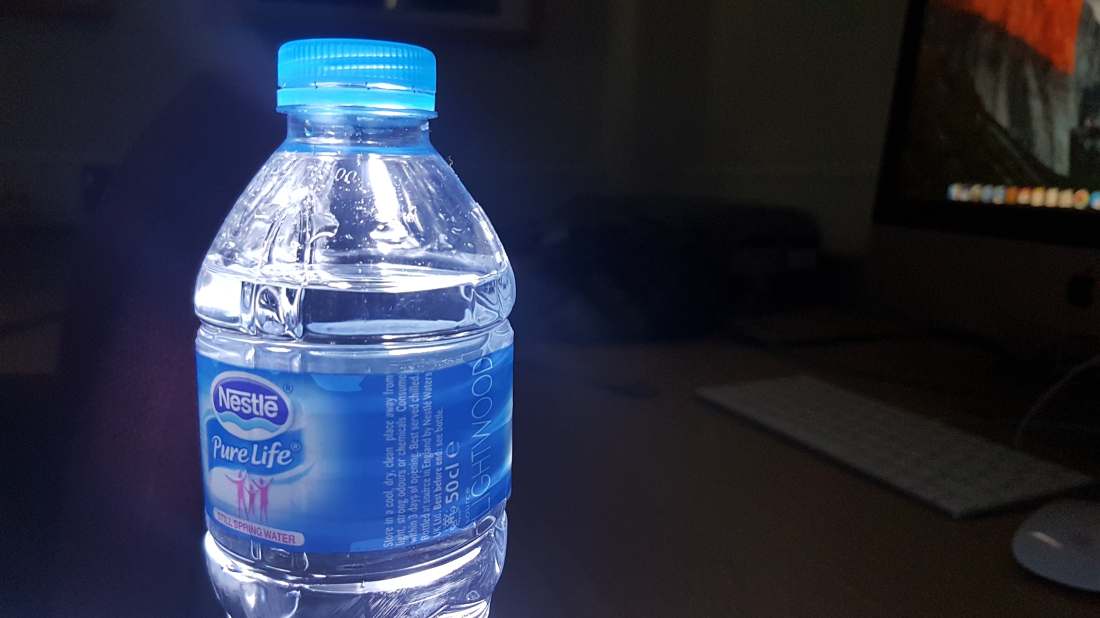
This picture has just one lighting, which is called an under-lighting. It only works with certain objects but it looks the best with transparent objects. While having the background completely dark and having the main focus on the bottle.

unbder-lighting 2.jpg

This is kind of like a Noir style but isn’t. It has a really dim backlight and a bright key, but isn’t showing contrast between bright and dark on the object because of this certain angle.

key and fill.jpg

Wind River

Wind River is a drama/mystery film that came out in 2017 set within the American Indian snowy reservations of Wyoming which is directed by Taylor Sheridan while the cast consists of Jeremy Renner, Elizabeth Olsen, Kelsey Chow and Jon Berthnal. This film also has a running time of 1:46:55 which is a perfect time for a film.

The film took over my previous favourite film, Jurassic Park because of how much depth the characters and plot has. The film’s plot is of a wildlife officer, Cory Lambert who finds a body of an 18 year old woman. When the autopsy was done is revealed that she was raped and abused. FBI agent, Jane Banner arrives alone to the investigation, as she teams up with the wildlife officer they meet themselves in danger while trying to solve the murder of the woman’s death in a place where a lot of murders happen but they’re never solved.

This film is very serious in tone, where you have long silent shots that make you feel gripped in while also having some intense scenes where you’re not sure wether or not the characters will live to find out the mystery.

One reason that makes this film special is how much depth is within it, as I said before. You can put together pieces of the film’s plot just by watching and listening, if you do that then you will appreciate this film even more. It shows how vulnerable people can be within this land but also having people who take it to their advantage.

The cinematography is my favourite aspects of films, this film makes me love it even more. Ben Richardson is the cinematographer, he provides these long, dreary shots of all the snow just makes you feel that anything can happen and no one can help you. All scenes will make you appreciate the cinematopgrahy

The movies score is, as many movies, great. While sticking to the Native American styled the slower paced music is obviously for the more silent scenes while the intense music is for the more dramatic, action scenes. My favourite track is called “Three Seasons in Wyoming”. This was beautify done by Nick Cave and Warren Ellis. This track is slow, dark, quiet and it just fits within the theme and tone of the film.

The Wind River Movie Trailer camera shots analysis.

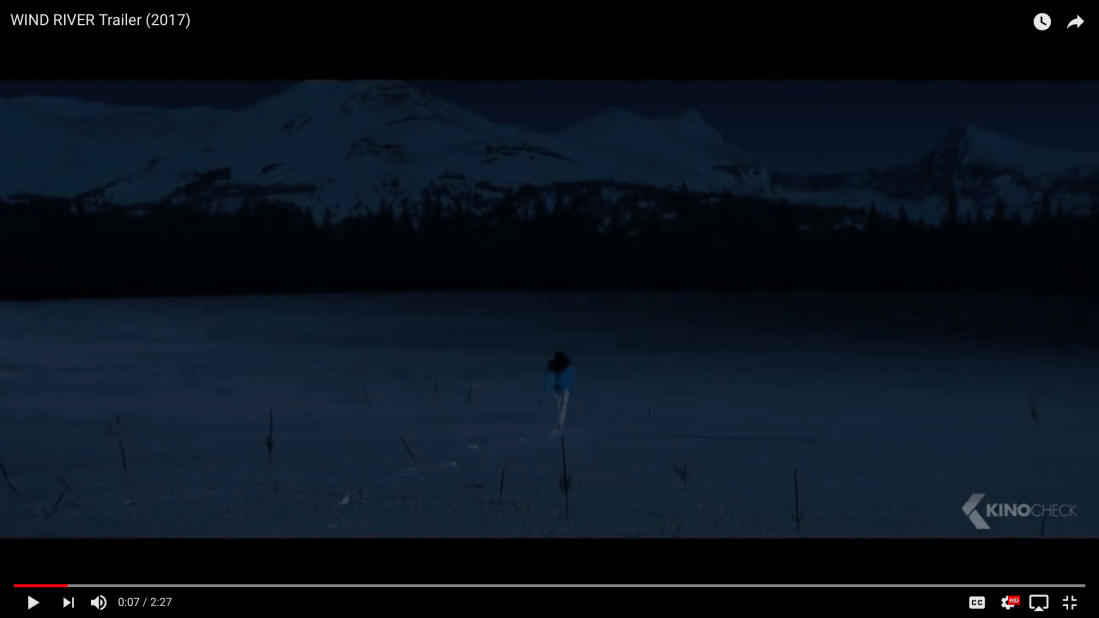
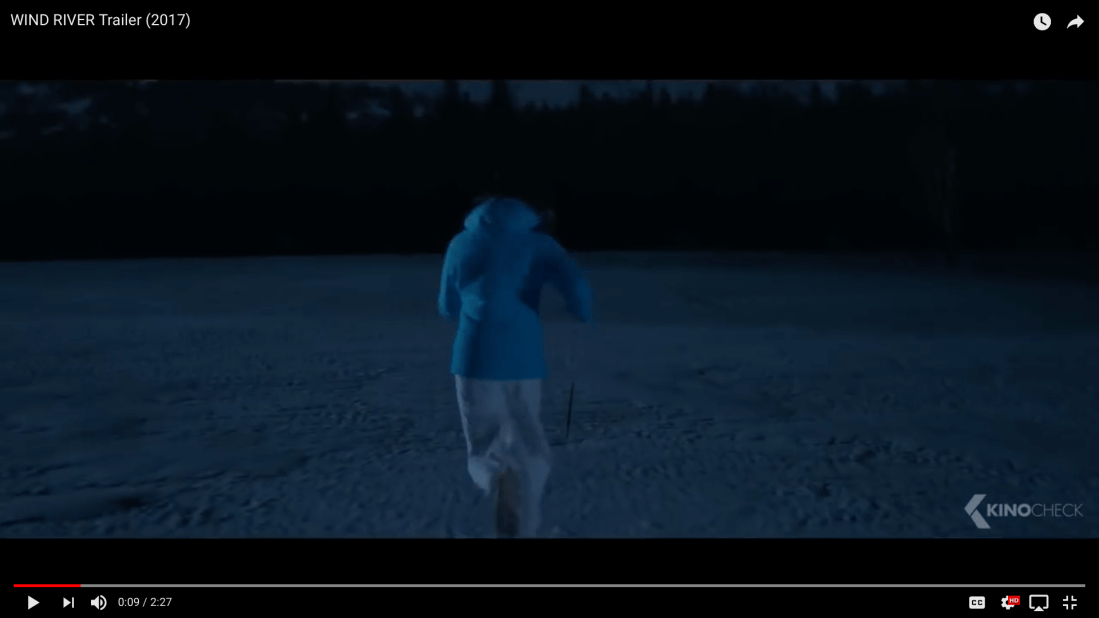
The first shot is of a woman running into the snow that is very far back. This would be an establishing shot as it is showing that this place is set within a very snowy area.

Screen Shot 2018-09-11 at 11.40.02.png

The shot then gets a little closer of the same woman running, this would be a long shot as it is showing her entire body and some of the environment.

Screen Shot 2018-09-11 at 11.40.55.png

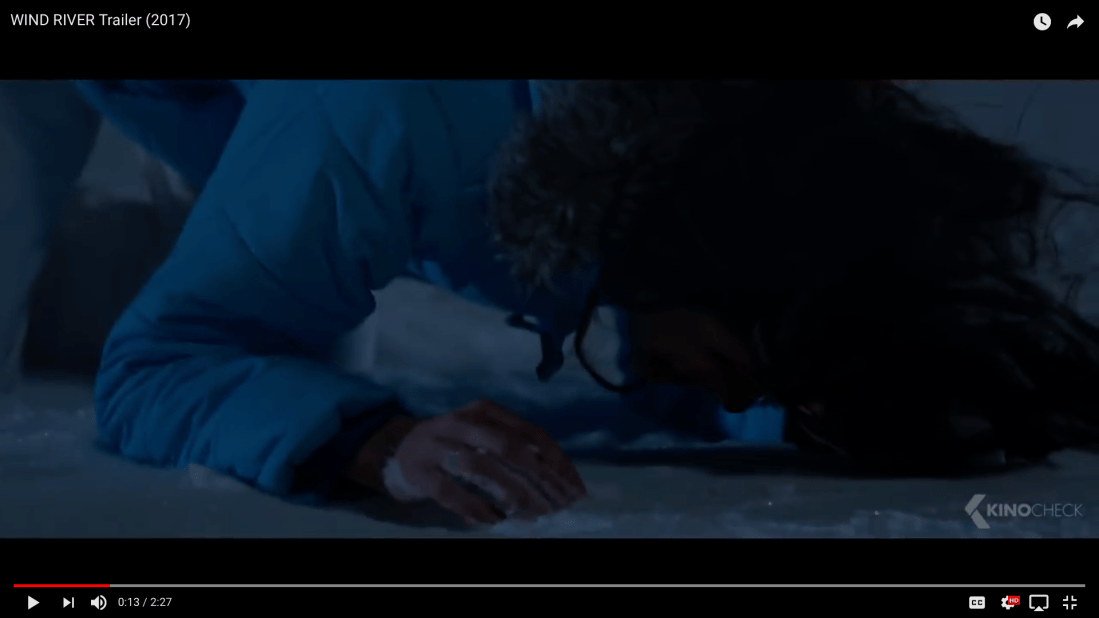
The next scene is of the same woman again falling over into the snow, this is a mid shot as it shows only half her body onto the floor.

Screen Shot 2018-09-11 at 11.41.28.png

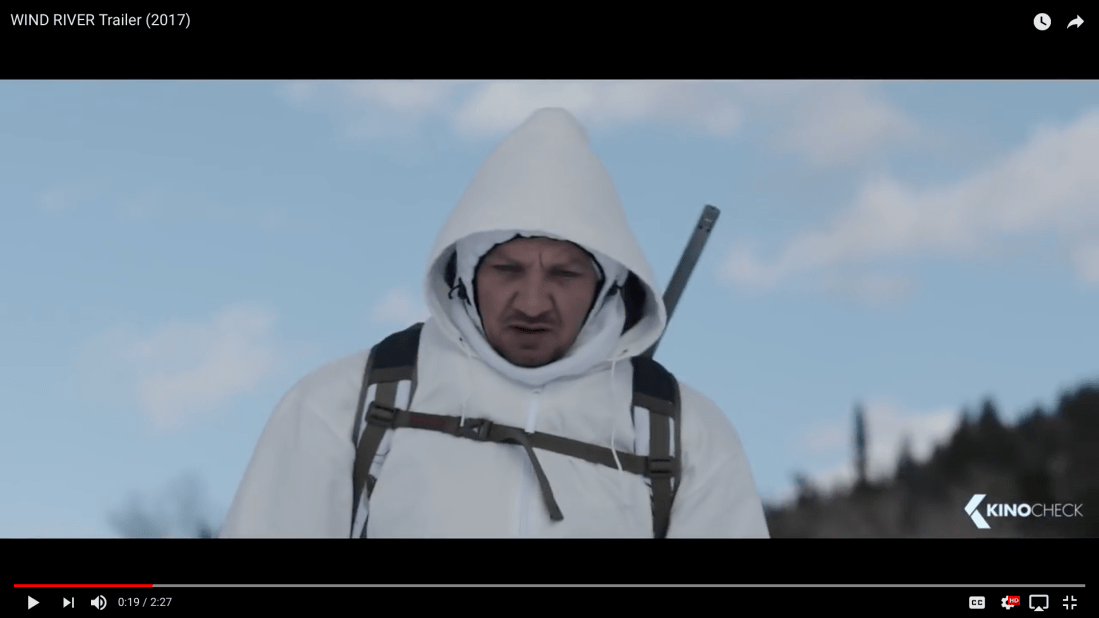
The next shot is introducing us to our main character, again this is a mid shot which is purposely trying to do this.

Screen Shot 2018-09-11 at 11.42.03.png

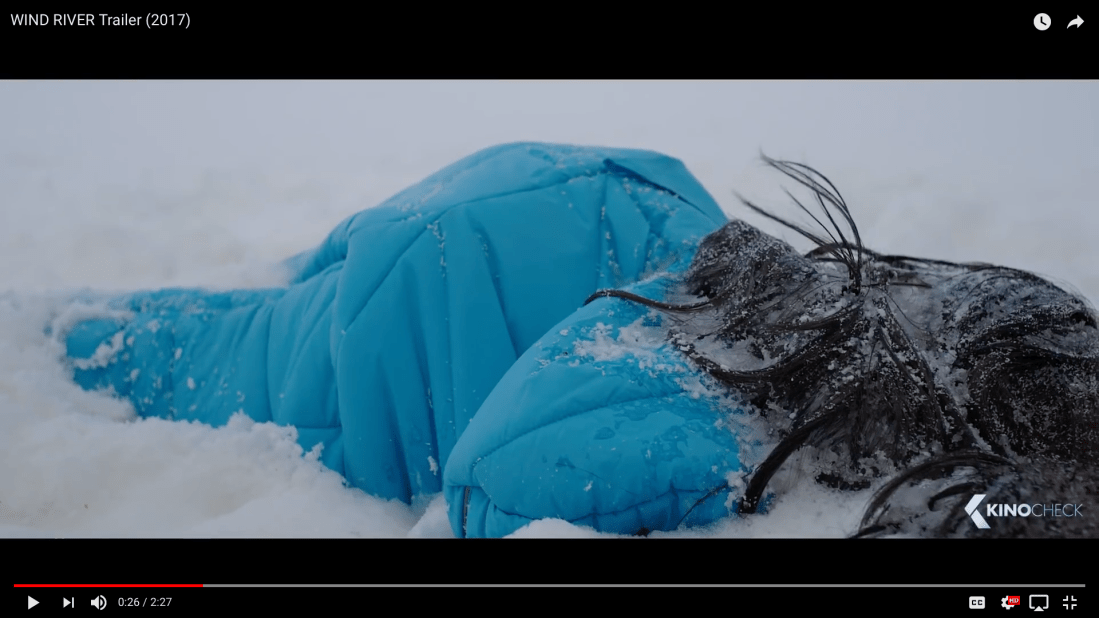
Next we have a close up of the woman from the first shots dead on the floor covered in snow and frostbite. This is to show that she is dead and that she is covered in snow.

Screen Shot 2018-09-11 at 11.42.32.png

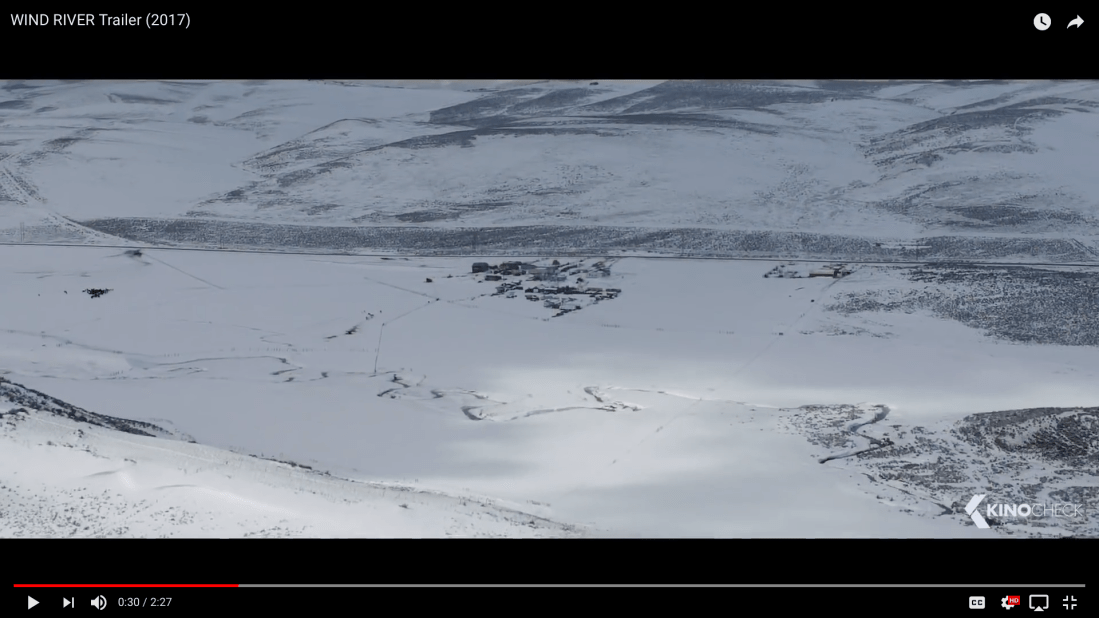
The next shot is another establishing shot showing off the snowy land, this time more open and it shows how dangerous and remote this place really is.

Screen Shot 2018-09-11 at 11.43.03.png

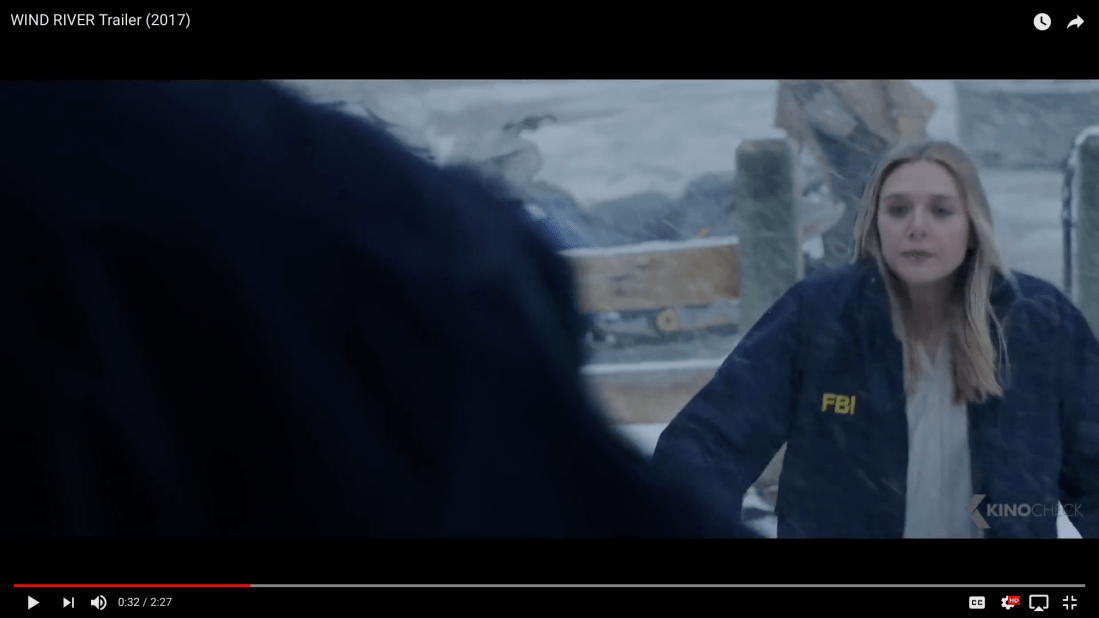
The next is a slight over the shoulder of someone looking at the FBI agent, which is intruding her, it’s also showing that we are there ready to meet her ourselves.

Screen Shot 2018-09-11 at 11.43.23.png

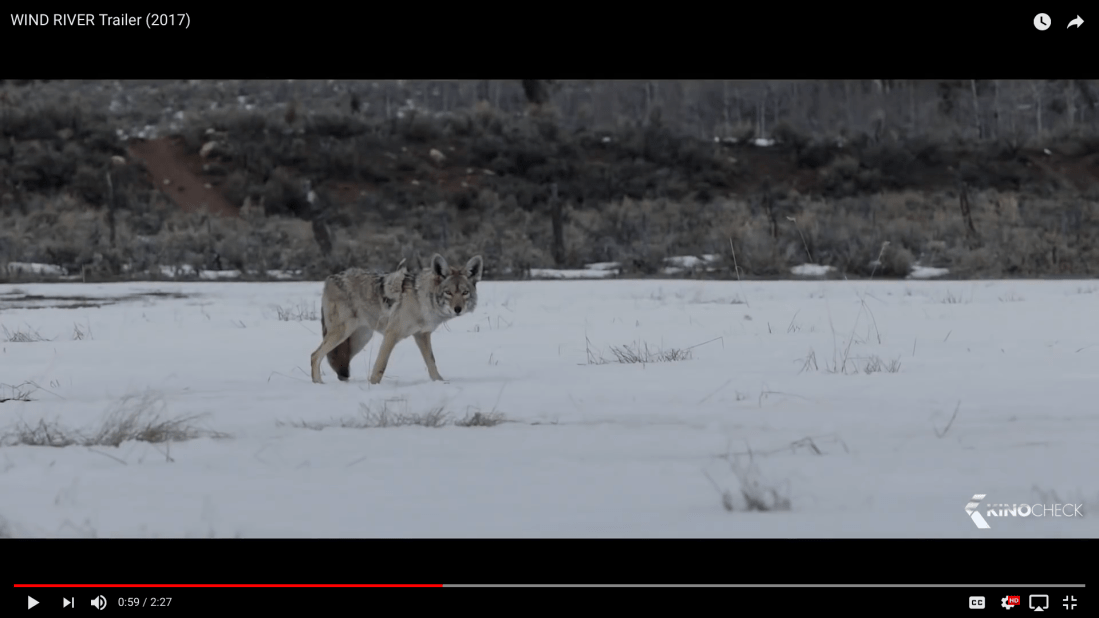
A few scenes after these we have this long shot of a wolf within the snow, this shows how these dangerous animals are also in this place and puts the risks higher.

Screen Shot 2018-09-11 at 11.43.57.png

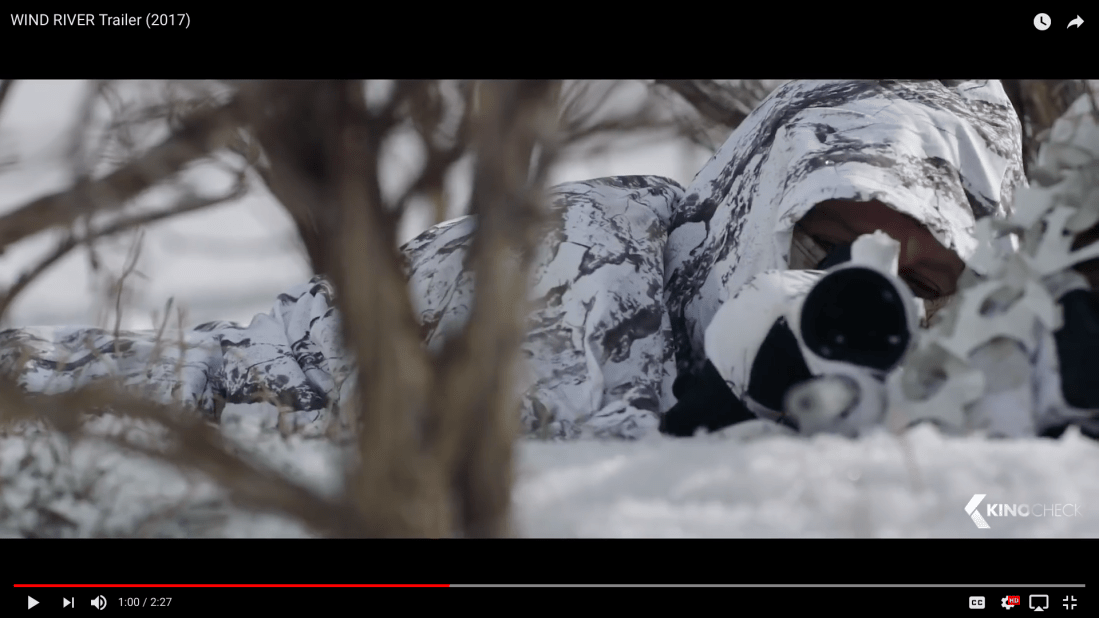
The shot right after shows the main character about to hunt the wolf in a close up shot showing that he can handle himself, that he knows this land, that he’s capable of solving the murder with the FBI agent.

Screen Shot 2018-09-11 at 11.44.12.png

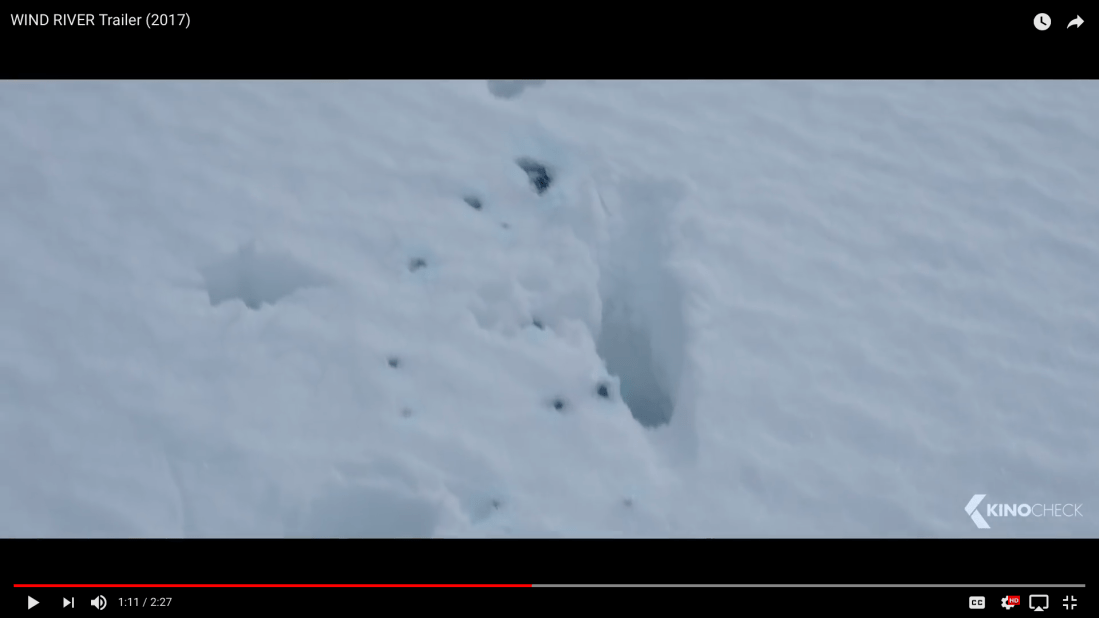
Next we have an extreme close up of footprints that are in the snow, this could be the woman footprints or someone else’s.

Screen Shot 2018-09-11 at 11.44.47.png

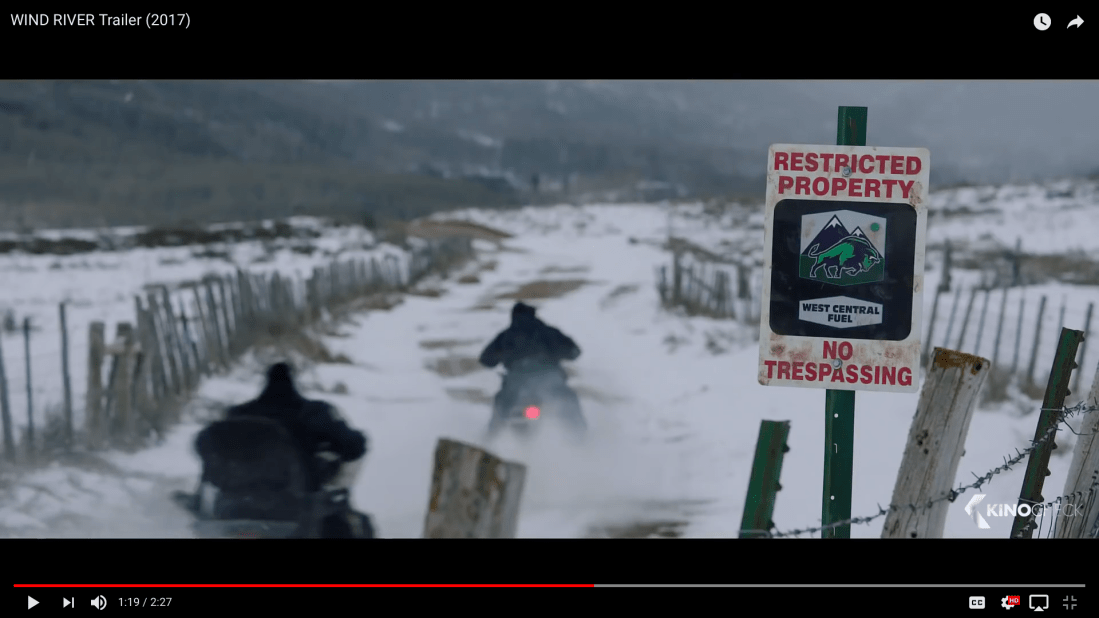
Next we have a close up of a sign that says “restricted area” while in the background it faintly shows the characters on the snow mobiles going past it.

Screen Shot 2018-09-11 at 11.45.17.png

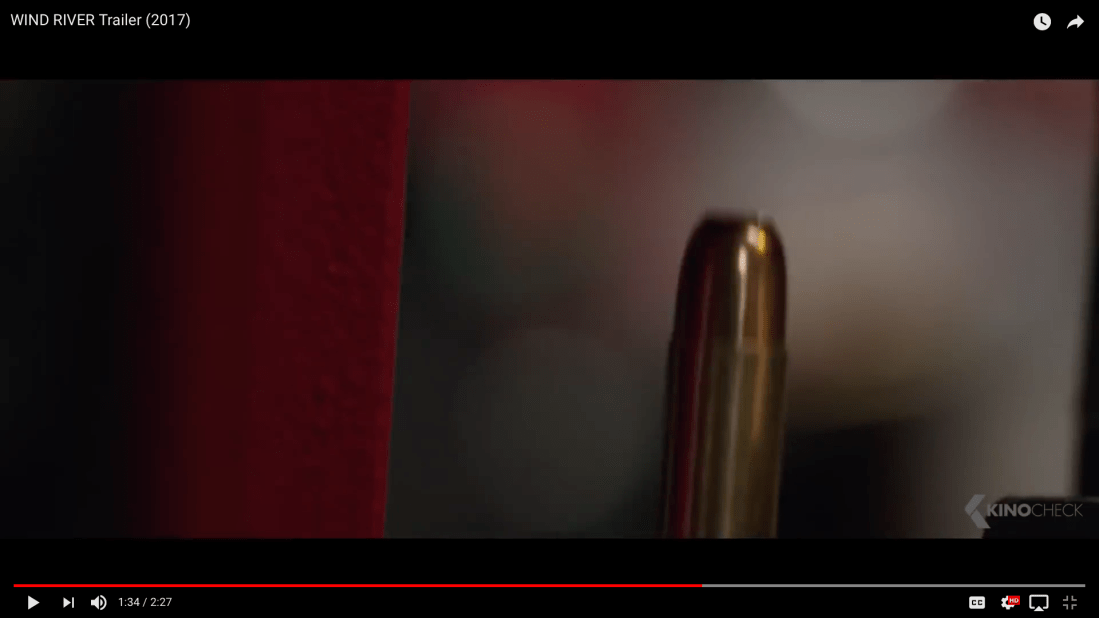
Next is an extreme close up of Cory Lambert either making bullets for his rifle or reloading it. This creates a feeling that they may have found a big lead which gets people excited.

Screen Shot 2018-09-11 at 11.45.57.png